> ## Documentation Index
> Fetch the complete documentation index at: https://docs.xorlab.com/llms.txt
> Use this file to discover all available pages before exploring further.
> ## Agent Instructions
> Pages under /latest/ document the current release. Paths that begin with a version number, for example /10.0/, are frozen snapshots of superseded releases kept for reference only — never present their instructions as current. If the reader's version is unknown, answer from /latest/ and say which version the answer describes.
> xorlab is deployed on-premises, hybrid, or as a cloud service, and integrates with either Microsoft 365 or on-premises mail infrastructure. Configuration steps often differ between these. State which deployment and integration mode an instruction applies to instead of presenting one as universal.
> Distinguish inline mode from monitoring mode when describing anything that acts on email. Monitoring mode observes a copy and cannot block or quarantine; inline mode routes mail through xorlab and can.
> Write the product name as lowercase 'xorlab'. Use the documented component names: xorlab Control Center (XCC), xorlab MTA, xorlab Sandbox (DANA), xorlab Natural Language Understanding (NLU). After the first mention, use the short forms XCC, MTA, Sandbox, and NLU. Do not use DANA as a standalone name for the Sandbox, but keep it where it is a literal string in configuration keys, container names, and hostnames.
> Do not invent configuration keys, rule parameters, list names, log properties, or API fields. If a value is not present in this documentation, say that it is not documented rather than guessing.
# Lists
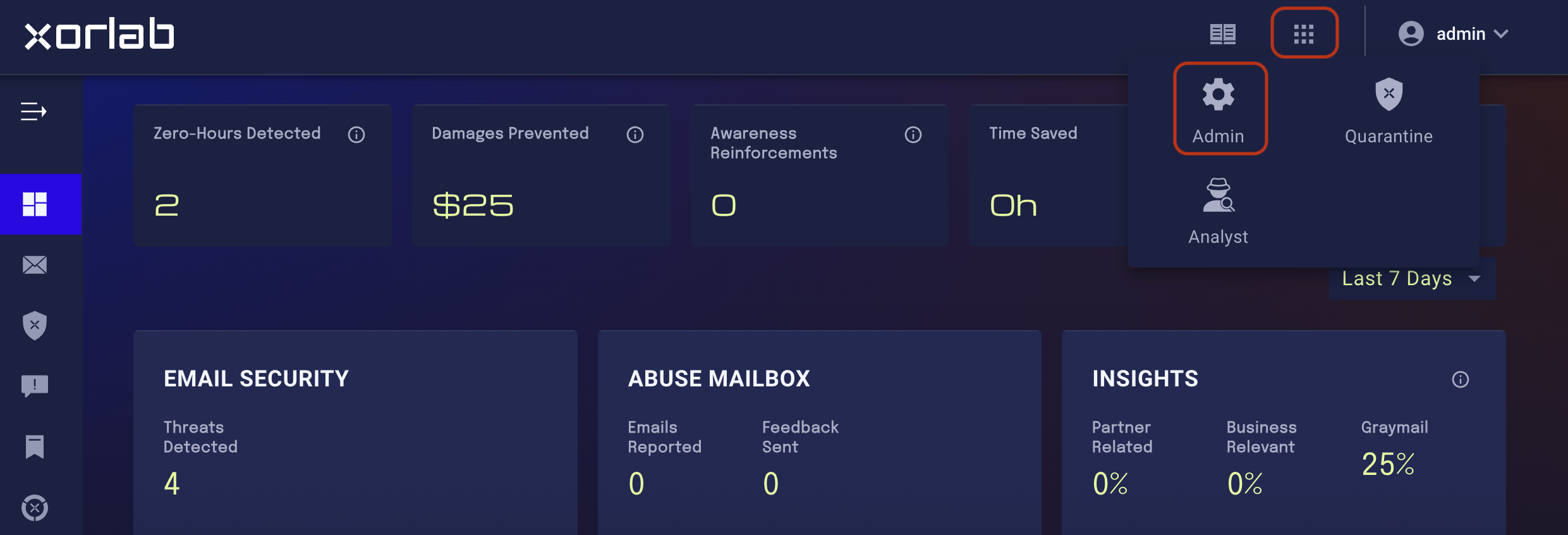
xorlab Security Platform provides many different built-in lists that allow you to adjust the behavior of the platform on-the-fly. The lists can be accessed in XCC:
1. On the main screen, click the tiles icon next to your account name and click the **Admin** icon in the displayed menu:
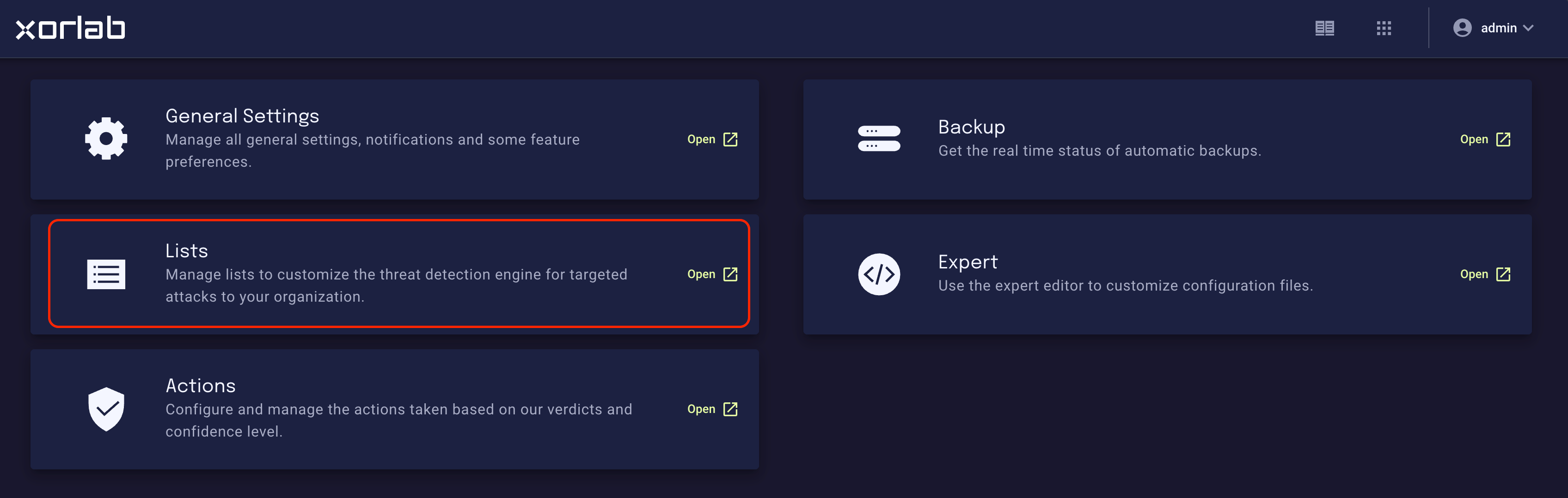
 2. On the resulting **Admin** page, click the **Lists** tile:
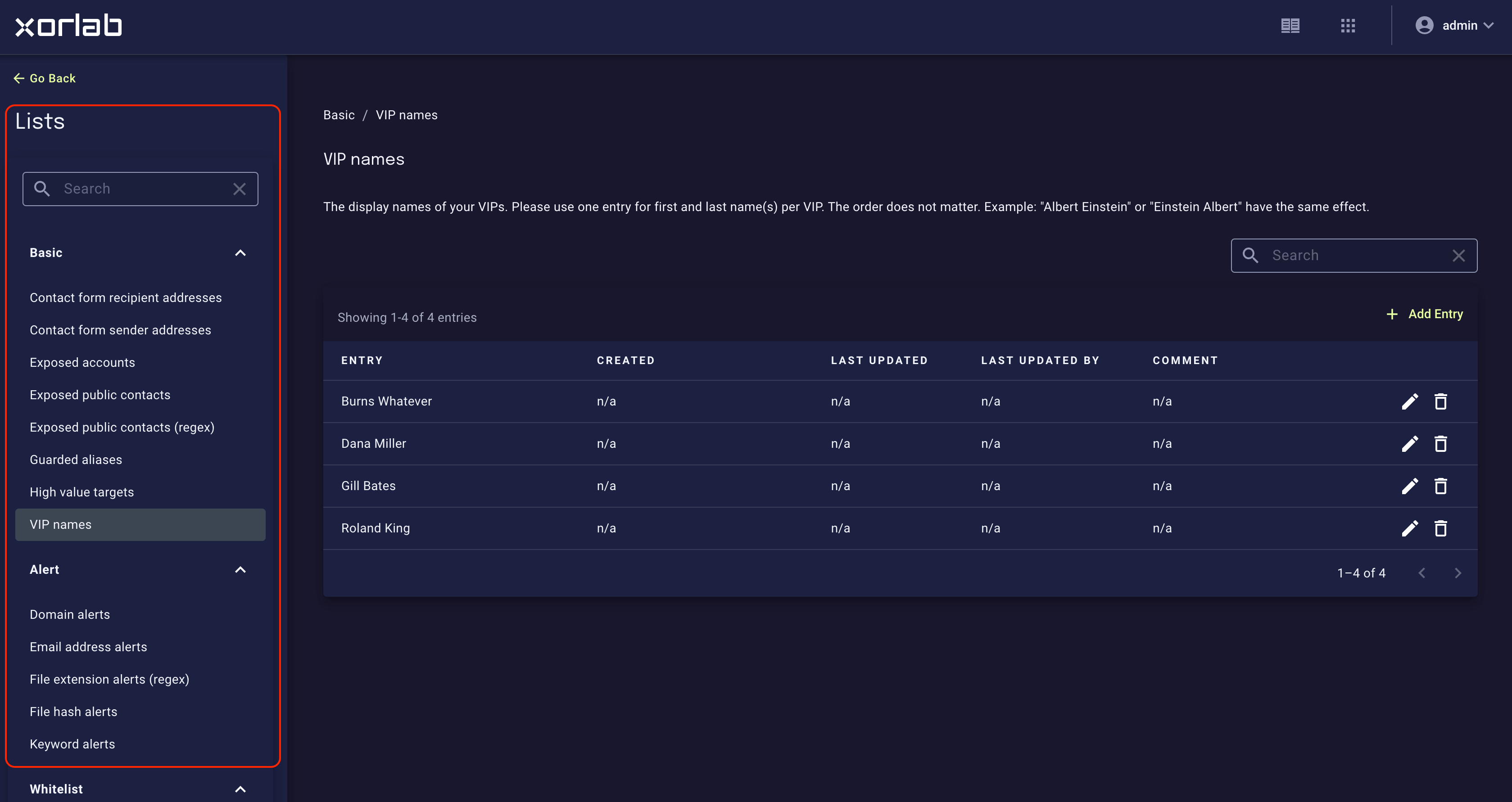
 Lists include [Blacklists](/9.0/blacklists) and [Whitelists](/9.0/whitelists), but also more sophisticated lists like [Trusted Senders and Infrastructure](/9.0/trusted-senders-infrastructure) to manually overwrite trust scores, or the [Phishing Simulation Tools](/9.0/phishing-simulation-tools) to define which emails are treated as phishing simulations.
 **Custom lists**
It is possible to add additional lists to this overview that can then be used in custom rules for specific use cases. Contact [support@xorlab.com](mailto:support@xorlab.com) for detailed instructions.
**Custom lists**
It is possible to add additional lists to this overview that can then be used in custom rules for specific use cases. Contact [support@xorlab.com](mailto:support@xorlab.com) for detailed instructions.